Posts

Showing posts with the label Brokers

Broker Exam Challenge

Image
Judicial challenges to the grading of the customs brokers license exam are not very common, but they happen. Usually, I have not been super supportive of the plaintiffs. See my maybe too mean-spirited post from 2006. On the other hand, I have gained a lot of respect for Mr. Byungmin Chae, who has been fighting with Customs over his score since taking the April 2018 exam. As background, broker license applicants who fail to pass the 80-question CBLE with a score of 75% or more may ask Customs to reconsider the grading on questions for which applicants believe they should have received credit. 19 CFR § 111.13(f) . If Customs does not change the grade, applicant may seek further review by the Executive Director of the Office of Trade. Any applicant that is not satisfied with the results of that review may sue the United States and ask the Court of International Trade to review the exam scoring.  Photo by Museums Victoria on Unsplash Mr. Chae missed passing the exam by eight questions...
Writ of Rachmones

 The Yiddish word rachmones  means compassion, mercy, or pity. It occasionally sneaks into legal discussions in cases where there is no clear legal right to relief but the applicant appears to be deserving of compassion or mercy. I remember first coming across this usage when reading Chutzpah , the memoire of the now troubling Alan Dershowitz in which he conveyed the story of working as a clerk for Judge David Bazelon of the U.S. Court of Appeals for the District of Columbia. According to Dershowitz, when a criminal defendant deserved compassion but had no strictly legal remedy, Judge Bazelon would request that his clerk find some basis on which to draft a "writ of rachmones." Dershowitz , Chutzpah , 58-59 (1992).  LEXIS tells me that Judge Berle Schiller of the U.S. District Court for the Eastern District of Pennsylvania used the same phrase in a 2020 opinion involving a criminal defendant who had been sentenced to prison for 15 years for securing home loans by fraudulen...

Ruling of the Week 2016.15: Customs Business

One of my least favorite areas of customs regulation has to do with the ability of related companies to provide compliance expertise through shared services. The problem arises because while a company can rely on its employees to conduct customs business on its own behalf, no one but a licensed customs broker can engage in customs business on behalf of a third party. That means that if you are an employee of Subsidiary Alpha of Acme Holdings Corp. you can't fully assist your sister company Subsidiary Beta with its customs compliance. That is true even though you may be the most qualified person in the entirely to the Acme Holdings extended family. While there is a space called "corporate compliance" in which the shared services model works just fine, managing the line of acceptable advice is difficult. The reason for this is  19 USC § 641(b)(1) , which requires a valid customs broker's license to undertake customs business on behalf of a third party. Customs busines...

One Protest Per Customer

I'm going to do this one quickly because I am busy and the case is straightforward, but still an important lesson. In Design International Group v. United States , the Court of International Trade reaffirmed the rule that an importer may only file one protest contesting the liquidation of an entry. In the case, the importer made two entries of pencils. When Customs liquidated the entries, it allegedly miscalculated the quantity and, as a result, incorrectly assessed duty. The broker for the importer filed protests for each entry. That right there is one protest per entry. Customs denied both entries. Subsequently, counsel for the importer filed a third protest challenging the denial of both prior protests. That is a second protest challenging the liquidation of each of the entries. When Customs and Border Protection denied that third protest, the importer filed suit in the Court of International Trade, using the third denied protest as the basis for jurisdiction. What do you ...

Duped "Importer" Liable for Customs Fraud

UPDATED: April 2, 2019. Note: As originally drafted, this post was based on the first version of the CIT slip opinion. As published, the initial opinion included the name of the broker involved. As amended, that person is identified only as "Individual A." The amended slip opinion is here . On the request of the broker and consistent with the Court's decision to not identify the broker, I have removed the name below. ________________________________ There have been several recent cases at the Court of International Trade that merit discussion. Two, in particular, are primarily of interest to lawyers. They show the truth of the old adage that bad facts make bad law. The first is United States v. Jeanette Pacheco . In this case, the United States of America is pursuing Ms. Pacheco to the tune of $2.6 million for her "role" in a customs fraud scheme. The "scheme" went like this: A licensed customs broker approached Pacheco in a nightclub. He offe...

Ruling of the Week 2015.25: No Refund for CPSC Restricted Goods

Image
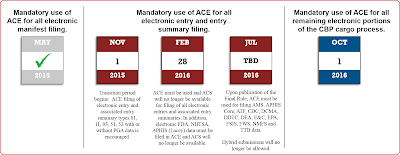
[UPDATE: I changed the title of this post to more accurately reflect the content, and to not look like an idiot.] Like a lot of other lawyers who do administrative law, I have lately been thinking about Customs and Border Protection's efforts to wrangle its partner government agencies into using the Automated Commercial Environment to submit data to Customs. If you have been dealing with Customs for the last year or so, you have probably seen this image. What is happening is the mandatory use of Customs' ACE system for electronic filing of data for other agencies. Previously, this data might have gone to Customs on paper or in a different electronic system. If this works, it will be great. If you are an importer, make sure your broker is up to speed and has invested in the software and training necessary to keep up with these changes. One of the agencies that is moving toward ACE implementation is the Consumer Products Safety Commission . CPSC regulates and enforces p...

Ruling of the Week 2015.5: Inadvertent Identity Hijacking

Usually, I am happy and proud to work with my counterparts at Customs and Border Protection. The good people there tend to do their jobs in an intelligent and professional manner. But then there is HQ H157616 (Sept. 22, 2014). [Update: It appears there is an error in the numbering of this Ruling. My prior link went to a different ruling. Try this one instead .] The facts here are simple. A customs broker filed an entry listing Lifestyle Enterprise Inc. as the importer of record. The subsequent Entry Summary also listed Lifestyle as the IOR and used Lifestyle's importer number. This was an error. Lifestyle was the domestic buyer and was supposed to be the consignee, not the importer. The seller, a company called Starcorp Furniture Inc. was supported to be the importer. The broker had no power of attorney authorizing it to act on behalf of Lifestyle. These facts seem to be undisputed. Also undisputed is that the merchandise involved was wooden bedroom furniture from China. I...

No License, No Brokerage

United States v. Freight Forwarder International, Inc . is another recent decision I can dispose of quickly. Here's the deal. A freight forwarder that employs a licensed customs broker but does not hold a corporate license cannot legally engage in customs business. 19 USC 1641(b)(5) and 19 CFR 111.4 . In this case, the defendant paid customs duties to Customs and Border Protection on behalf of importers and invoiced the importer. That is transacting customs business. CBP sought a penalty of $10,000 and the defendant failed to respond. What follows in the reported decision is the Court of International Trade essentially ticking off the boxes showing that the United States has taken the necessary administrative and litigation steps necessary to collect a default judgment. Not surprisingly, the United States Department of Justice did just that and the Court entered a default judgment of $10,000 against the defendant.

Ruling of the Week 5: Right to Make Entry

There is an important and sometimes silly aspect of customs law involving who has the right to make entry. There is a statutory requirement that the importer of record for merchandise entering the U.S. be a party with the right to make entry. Specifically, the IOR may be the owner or purchaser of the goods or a broker appointed on behalf of the owner, purchaser or consignee. That is fine and seems clear. The problem is that it just does not fit with all of the crazy ways international transactions get structured these days. For example, what if Acme Corp. Canada owns some merchandise located in Canada that it wants processed in the U.S. by a third party. There is no purchaser in the U.S. because Acme Canada continues to own the goods. Acme Canada could be the (non-resident) importer as the owner. But, what if Acme Corp. USA decides to offer to help and act as importer? That might be an issue. Acme USA is not the owner (that is Acme Canada), it is not the purchaser, and because the good...

Two for One

This being the last day of 2013, I am trying to do some real and virtual desk cleaning. Part of that is making sure I have reviewed the relevant CIT cases for the year. It turns out I am behind by three. Here is a brief discussion of two of them: United States v. Alejandro Santos and Alejandro Santos, CHB This decision follows the entry of a default judgment against a customhouse broker who apparently misidentified entries of pesticides as animal fat and misidentified the importer of record. The broker also made unsupported claims for duty-free treatment under the NAFTA and other violations. Customs and Border Protection issued a prepenalty and penalty notice informing him of a $30,000 penalty to be assessed. Santos waived service but did not appear to defend the claims against him. The first round of this case was discussed here . Given the facts presented in the unchallenged complaint, the Court of International Trade found that Santos violated a number of regulations enforced ...

Broker Penalty by Default

I am barely back from a brief vacation. I note that in the ramp up to being a way from the office and while I was gone, the U.S. Court of International Trade did not stop pushing out decisions. So, this is the first in what should be a small group of catching-up posts. Unit ed States v. Alejandro Santos is an action to recover a civil penalty from a licensed customhouse broker. That, in and of itself is relatively unusual. In the ordinary circumstance, the importer bears the brunt of the penalty. If you see a broker penalty case, you can usually assume there is some interesting story in the background. In this case, we don't get much in the way of background because the defendant failed to respond to the complaint. Thus, the only question here is whether the uncontested facts as asserted by the government are sufficient to establish its right to recovery. The bottom line is that the government was able to plead facts sufficient to satisfy the Court that it was entitled to a de...

Reservist Permitted to Take Broker's Exam

Below is part of the text of a press release from my office. I am happy about this result so far and hope that Customs and Border Protection follows up with some public statement letting all Reservists know that they may become licensed customhouse brokers without having to give up their service in the Reserve. William A. Nusbaum, a member of the U.S. Army Reserve, was permitted to sit for the April 2, Customs Broker Licensing Examination administered by U.S. Customs and Border Protection, which has also agreed that his status as a member of Reserve will not prevent him from receiving a broker’s license. This is a direct result of a lawsuit filed on behalf of Mr. Nusbaum in the U.S. Court of International Trade by Barnes, Richardson & Colburn. Prior to filing the suit, Mr. Nusbaum had been informed that his status as a member of the Army Reserve disqualified him from taking the test or being granted a license because he is an employee of the United States government. Barnes, ...

Proposed Changes to In-Bond Process

I'm just going to throw this out there for my broker and importer friends. Yesterday, Customs and Border Protection published a proposed rule to modify the in-bond process.  Here is a link to the notice . Here is the summary in full: Under the U.S. Customs and Border Protection (CBP) regulations, imported merchandise may be transported in-bond. This process allows imported merchandise to be entered at one U.S. port of entry without appraisement or payment of duties and transported by a bonded carrier to another U.S. port of entry provided all statutory and regulatory conditions are met. At the destination port, the merchandise is officially entered into the commerce of the United States and duties paid, or, the merchandise is exported. CBP is proposing various changes to the in-bond regulations to enhance CBP's ability to regulate and track in-bond merchandise and to ensure that the in-bond merchandise is properly entered and duties are paid or that the in-bond merchandis...

Goodbye Courtesy Notice

So, I've been busy. It happens. One of the many things I need to post is that Customs and Border Protection has finalized a rule to eliminate the mailed paper copy of the courtesy notice of liquidation for entries that were filed electronically via the Automated Broker Interface. As it stands, CBP provides an electronic notice of liquidation to the broker via ABI and mails the paper courtesy notice to the importer. Going forward, importers who want to monitor liquidations will have to do so via the Automated Commercial Environment Portal. If you are one of the small percentage of people who file paper entries, you will still get paper courtesy copies. As a practical matter, this may not make much difference. The official legal notice (which almost no one ever sees) is the posting at the customhouse. Many importers simply assume liquidation happens 314 days after entry. Others get reports from their broker. This state of affairs, together with the estimated $3 million in annua...

Filer Code Safe for Now

Customs and Border Protection assigns licensed customhouse brokers unique filer codes. These codes allow the broker to have electronic access to Customs.  The filer code, therefore, effectively permits the broker do business in a modern commercial environment. Absent an active filer code, the broker may as well have to operate using carrier pigeons and smoke signals. Consequently, when CBP threatened to deactivate its filer code, Lizarraga Customs Broker went on the offensive. The issue reached the Court of International Trade. The procedural status of the case is a little tangled. It appears that plaintiff wanted an injunction to prevent CBP from deactivating its filer code. While that request was pending, the parties submitted their complaint and answer. Eventually, the United States government filed a so-called "Confession of Judgment" in favor of Lizarraga. According to the government, this should have resolved the case because the US has agreed not to suspend the ...