Posts

Showing posts with the label Protests

Acquisition 362 and Protests of Countervailing Duties

Image
Welcome back to what I hope is a more consistent flow of updates. I have a couple in the hopper, so come back soon. Importers of goods subject to antidumping and countervailing duties often find themselves dealing with unexpected compliance issues. Acquisition 362, LLC v. United States , a recent decision from the Court of Appeals for the Federal Circuit, is a good example of how this can go sideways.  Aquisition is an importer of tires from China that are subject to a countervailing duty order. As a result, Acquisition deposited CV duties at the rate of 30.61%, which was the rate applicable to tires from "all-other" producers and exporters at the time of entry. When Commerce instituted a review of the deposit rate, it instructed Customs to continue to suspend the liquidation of entries from companies participating in the review, including a company known as Shandong Zhongyi, which was Aquisition's nominal suppler.  Unfortunately for Aquisition, Shandong withdrew from the...

When is a Protest Allowed?

Lawyering is sometime a creative endeavor. As regulatory lawyers, that does not happen often enough. We rarely get the satisfaction of helping individuals resolve issues that impact their personal liberty or property. That’s OK. I am perfectly happy without a lot of human drama in my practice. On the other hand, I do enjoy stretching my creative lawyering skills. In Erwin Hymer Group North America, Inc. v. United States, counsel for the plaintiff probably had some fun dealing with the issue presented. A reasonable way of describing what happened is this: Customs erroneously approved a protest that should have been suspended. When it failed to pay a refund on the protested entries, Hymer sued. Hymer’s argument comes done to the ancient proposition of school-yard jurisprudence “No take backs.” As with all these procedural cases, the facts matter. When Hymers filed its protest, there was litigation already pending in the Court of International Trade on a similar question. Hymers...

ACE as Overlord

Image
Apects Furniture International v. United States is such a painful example of customs litigation, that I have started and deleted draft posts a number of time. So, I am just going to bottom line it and move on my life. The issue here is whether Aspects properly protested multiple liquidations on a single protest filed in the Automated Commercial Environment. The protests relate to a rate advance to collect antidumping duties on wooden bedroom furniture. There are nine entries at issue. Apsects protests [spoiler] all nine in the system that Customs and Border Protection designed and made available to the trade. The narrative section identified a single relevant entry number, which was used as the "lead entry." The government asserted that the remaining eight entries were not properly subject to the protest. However, the Court pointed out, when Apects filed the protest, it (or its representative) used the function of the system that allows the user to "Add Additional E...

Consolidated Fibers: What the EAJA?

Consolidated Fibers, Inc. v. United States involves an importer’s motion for attorneys’ fees under the Equal Access to Justice Act (“EAJA”). And, it is a cautionary tale for importers and customs lawyers. The underlying facts are not too complicated. Consolidated entered polyester stable fiber from Korea. At the time of entry, it deposited the 7.9% estimated dumping duties that were then due. Because the producer was subject to administrative review, the liquidation of the entry was suspended. On December 10, 2007, Commerce published the results of the review and determined the assessment rate to be 48.14%. On January 14, 2008, Commerce issued instructions to Customs to liquidate the entries at the assessment rate. CBP failed to act on those instructions until May 6, 2011 when it published a bulletin notice of liquidation stating that the entry liquidated by operation of law on June 10, 2008 at the 7.9% deposit rate. But, shortly thereafter, on June 17, 2011, CBP “rate advanced” th...

Deemed Liquidation and Notice

[UPDATE: Sometimes, Congress fixes things. That is the case here. The Trade Facilitation and Trade Enforcement Act of 2015 includes, at § 911 a fix for the issue discussed in this post. The relevant amendment changes the existing law "by striking 'on which notice of the original liquidation is given or transmitted to the importer, his consignee or agent' and inserting 'of the original liquidation'.” This should make the relevant date the date on which the deemed liquidation occurs, not the date of notice, which is how it should be (if you ask me).] The second recent case from the Court of International Trade involves the deemed liquidation of an entry. It is United States v. Great American Insurance Company of New York . This is a collection case in which the United States is seeking $50,000 from a surety for unpaid antidumping duties, plus pre-judgment and post-judgment interest. For purposes of my own time management, I am just going to give you the take-aw...

One Protest Per Customer

I'm going to do this one quickly because I am busy and the case is straightforward, but still an important lesson. In Design International Group v. United States , the Court of International Trade reaffirmed the rule that an importer may only file one protest contesting the liquidation of an entry. In the case, the importer made two entries of pencils. When Customs liquidated the entries, it allegedly miscalculated the quantity and, as a result, incorrectly assessed duty. The broker for the importer filed protests for each entry. That right there is one protest per entry. Customs denied both entries. Subsequently, counsel for the importer filed a third protest challenging the denial of both prior protests. That is a second protest challenging the liquidation of each of the entries. When Customs and Border Protection denied that third protest, the importer filed suit in the Court of International Trade, using the third denied protest as the basis for jurisdiction. What do you ...

Ruling of the Week 2015.25: No Refund for CPSC Restricted Goods

Image
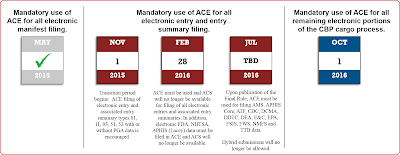
[UPDATE: I changed the title of this post to more accurately reflect the content, and to not look like an idiot.] Like a lot of other lawyers who do administrative law, I have lately been thinking about Customs and Border Protection's efforts to wrangle its partner government agencies into using the Automated Commercial Environment to submit data to Customs. If you have been dealing with Customs for the last year or so, you have probably seen this image. What is happening is the mandatory use of Customs' ACE system for electronic filing of data for other agencies. Previously, this data might have gone to Customs on paper or in a different electronic system. If this works, it will be great. If you are an importer, make sure your broker is up to speed and has invested in the software and training necessary to keep up with these changes. One of the agencies that is moving toward ACE implementation is the Consumer Products Safety Commission . CPSC regulates and enforces p...

Finality of Liquidation and the Loss of Defenses

Most people assume that when sued by the United States for unpaid customs duties, taxes, fees, and interest, the defendant will have an opportunity to assert all available defenses to the claim against it. That is technically true. The question is which defenses are available. United States v. American Home Assurance Co. , has made the answer to that question a bit clearer, but maybe not in a good way. American Home ("AHAC") is the surety on a number of bonds covering the importation of mushroom and crawfish tail meat from China. Both of those products are subject to antidumping duty orders. Customs and Border Protection liquidated the entries and assessed antidumping duties. When the importer defaulted, the government tried to collect from AHAC and informed AHAC of its intent to seek post-judgment interest. AHAC protested the demands for payment of duties and interest. Customs denied the protests.  Therein lies the problem. Section 1514 of the Tariff Act of 1930 ( 19 USC...

Prejudgment Interest: Statutory and Equitable

You may recall that in United States v. American Home Assurance Company , the U.S. Court of International Trade held that a surety could not be held liable for statutory prejudgment interest owed by the importer because the statute reaches only "ordinary" duties and not antidumping duties. However, in the same case, the CIT held that the government is entitled to prejudgment interest under equity. The Court of Appeals for the Federal Circuit has now reversed the CIT on the first point and vacated the decision with respect to the second point. The facts you need to know are few. American Home was the surety for an importer of crawfish tail meat from China, which is subject to an antidumping duty order. At the time of entry, the deposit rate applicable to the specific exporter was zero, which is convenient. But, following a review, liquidation occurred with a 223.01% assessment rate, which was inconvenient. The importer defaulted and Customs and Border Protection sought paym...

Thank You, Otterbox

As previously discussed , the tariff classification of plastic cases for mobile phones, tablets, and similar electronic devices has been subject to much dispute. Customs and Border Protection has long held that they are usually, but not always, classified in Heading 4202 as if they are trunks, attaché cases, or musical instrument cases. I previously explained, in a fair amount of detail, why I think this is wrong. Turns out, barring interventions from the Court of Appeals, that I was right. Being right is a circumstance that always makes me happy. In a thorough and thoroughly well reasoned decision , the Court of International Trade has decided that cases for iPhones and similar products imported by Otter Products ("Otterbox") are not classified in Heading 4202. Rather, they are articles of plastic in Heading 3926. Customs had classified the goods in 4202 on the basis of Note 2(m) to Chapter 39, which excludes from Chapter 39 "containers" of Heading 4202. The pr...

The Rolls Royce of Protests

What makes for a valid protest is one of those ever green questions that generates litigation before the U.S. Court of International Trade. The most recent entry in the parade of cases on this topic is Ovan International Ltd. v. United States . The background here is simple. Carriage House Motor Cars came into ownership in the U.S. of a 1958 Royce Silver Cloud. As will happen when one owns a classic car, Carriage House planned to sell it at auction in the UK. The car did not sell and was returned to Carriage House in the U.S. with Ovan acting as the customs broker and the Importer of Record. At the time of entry, Ovan claimed the entry should be duty free under HTSUS item 9801.00.25. Customs issued a Notice of Action stating its intent to liquidate the vehicle as a dutiable passenger car at 2.5% There was some back and forth between counsel for Ovan and Carriage House on the one hand and Customs on the other hand. On February 22, 2013, Customs liquidated the entry as dutiable and O...