Posts

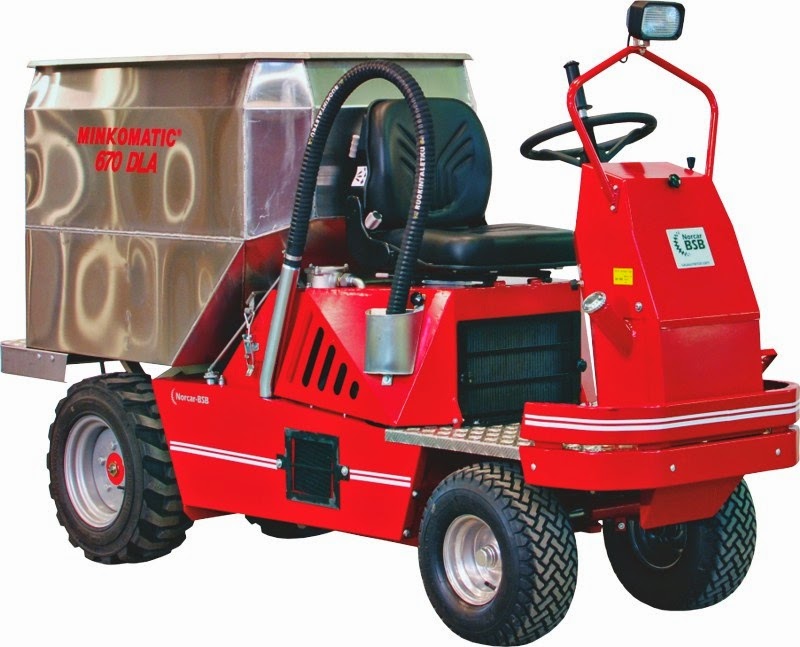
Ruling of the Week: The Minkomatic
Image
Maybe this will be a continuing feature, maybe not. Either way, it is not at all unusual for me to see rulings that I find amusing for one reason or another. And, in almost all cases, I know that it is not amusing to the people involved who consider the product involved to be their job. So, I issue a blanket apology to anyone I might offend. Today, I was amused to see a ruling on the Minkomatic 660 and 670 feeder trucks. You can find out everything you ever wanted to know about self-propelled vehicles designed to deliver feed to livestock in pens here . The issue presented to Customs and Border Protection was whether the Minkomatic truck is classifiable as a vehicle of Chapter 87 or as agricultural machinery of Chapter 84. Because it is equally equipped for mink feeding, Customs determined that it is not principally used for transport. That took it out of Chapter 87. Customs then also determined that mink husbandry is an agricultural exercise. That puts the Minkomatic ...

What's a Protest?

A protest is a very important document. When an importer lodges a protest with Customs and Border Protection, the importer is telling CBP that it disagrees with a decision Customs made when liquidating an entry. Absent a protest, the liquidation becomes final and is not subject to challenge. If the importer files a protest and CBP denied it, the importer can go to the Court of International Trade to challenge the denial. In many cases, if there is no valid protest, there is no way to get into court. To be valid, a protest has to be timely. Today, that means 180 days from the date of liquidation. That was not always the case. The protest period used to be 90 days. The transition from 90 to 180 days was not smooth and that seems to be the underlying problem in Puerto Rico Towing & Barge Co. v. United States , a recent decision of the Court of International Trade. The case involves an effort to protest the collection of duties on ship repairs performed on a U.S. flag vessel while ...

Dependable Classifications

When we last left Dependable Packaging Solutions, Inc. v. U.S., the Court of International Trade agreed with U.S. Customs and Border Protection that certain inexpensive bud vases were properly classified as "glassware of a kind used for . . . indoor decoration or similar purposes" (Heading 7013) rather than as "carboys, bottles . . . and other containers, of glass, of a kind used for the conveyance or packing of goods" (Heading 7010). Dependable appealed to the Court of Appeals for the Federal Circuit, which has now rendered its judgment. The interesting issue Dependable raised on appeal has to do with the Explanatory Notes . [Note from Larry: Dear Thomson Reuters and Boskage, you're welcome.] The Explanatory Notes are not binding on Customs or the Court. Nevertheless, because they represent the views of the folks who wrote the Harmonized Tariff, they are deemed to be relevant and persuasive authority on the meaning of a tariff term. In this case, the Explan...

Catching Up

Image
I am behind on my blogging. As I have said in the past, that usually happens when I am busy at work, which is a good thing. So, to play a little catch up, I am going to combine several recent cases in this single post. Tempura Tempest First up, the Federal Circuit ruled on the classification of tempura in a case called R.T. Foods, Inc. v. United States . We discussed the Court of International Trade decision here . The government asserted that cut, flour dusted, fried, and flash frozen vegetables are classified in HTSUS 2004.90.85, which covers "Other vegetables prepared or preserved otherwise than by vinegar or acetic acid, frozen, other than products of heading 2006: Other vegetables and mixtures of vegetables: Other: Other, including mixtures." According to R.T. Foods, the products are classifiable in HTSUS 2106.90.99, which provides for "Food preparations not elsewhere specified or included: Other: Other: Other: Frozen." The latter classification is entitled...

Riddell Me This: When are Football Uniforms Not Sports Equipment?

Image
Answer: when they are classified under the Harmonized Tariff Schedule of the United States. This classification decision in Riddell v. United States , addresses one of my pet questions. At some point, is apparel designed for use in conjunction with participating in sports "sports equipment" rather than apparel? The products at issue in this case are football jerseys, pants, and girdles. Each of them is designed to be worn in conjunction with protective football pads (both hard and soft). However, no pads were included with the merchandise when imported. Customs and Border Protection classified these items under chapters 61 and 62 if the HTSUS. Riddell argued that the merchandise was more properly classified as "Football . . . equipment . . . ." under subheading 9506.99.20. Because the imported goods were not imported with or otherwise incorporate padding or other protective features, the Court of International Trade held that the merchandise is clothing, not spo...

Ford Recon Decision Redux

Back in 2004 and 2005, Ford Motor Company imported some vehicles from the UK, which I will assume were Jaguars even though that is completely irrelevant. Ford flagged the entries for reconciliation. When it filed the reconciliation entry, Ford sought a refund of overpaid duties. Ford did not get the refunds and ended up in the Court of International Trade seeking to recover overpaid duties on the grounds that the reconciliation entries liquidated by operation of law at the amount of duty asserted by Ford. Because I image these vehicles as expensive Jaguars, I assume a lot of money is involved. Customs, for its part, believes that the liquidation of the reconciliation entries were properly extended and that Ford was given proper notice. The Court of International Trade agreed with the government in this opinion. The dates involved become important to see how this plays out. Ford commenced the action on April 15, 2009. At that time, CBP had not liquidated any of the entries. However,...

Nerd Alert

Image
I teach trade remedies law at the Center for International Law at the John Marshall Law School . It turns out that drafting an exam is a fairly difficult task that takes some level of inspiration. This year, I decided to let my geek flag fly and craft an exam based on an original comic book scenario. After grading the tests, I sent it to the completely awesome Law and the Multiverse , which was kind enough to run it as a guest post. Yesterday, it was picked up the by also awesome Above the Law . For me, that's a good day. Read the exam and the resulting discussion at Law and the Multiverse. Can you tease out all the references to the DC universe? Jean Loring, Esq. and Ray Palmer, Hero.

Make it so . . . .

Image
Speaks for itself. Stolen from Julie Whitt by way of Pete Mento . Hat tip to both.

Don't Blink

We have previously considered the narrow slice of time in which an importer can file a protest against the exclusion of merchandise by Customs and Border Protection. That opportunity dissolves if Customs seizes the merchandise before the case is brought before the United States Court of International Trade. See here and here for prior discussions on this topic. In Blink Design, Inc. v. United States , the Court of International Trade had to decide whether the merchandise had been seized and, if so, whether that seizure occurred before the case was properly before the court. The background is interesting and hints at possible shenanigans by the importer leading to fairly strong action by CBP. The triggering circumstance for this case is that CBP discovered that containers of imported wearing apparel were found to contain approximately twice the quantity of merchandise as was shown on the invoices and declared to CBP. To Customs, that might look like an attempt to smuggle clothing ...

Happy Tariff of Abominations Day

"What's that," you ask. It's my holiday for customs lawyers and compliance professionals. Read all about it here . I'm a couple days late, but that's OK since I am the only one celebrating.

Supreme Court Takes No Action on Customs Cases

Image
A couple interesting customs matters were presented to the Supreme Court this term. Unfortunately, the Court declined to hear either. The first was the Deckers case about the meaning of the tariff term "slip on" as applied to footwear. The reason this was potential Supreme Court fodder was that the Court of International Trade and the Court of Appeals for the Federal Circuit gave weight to a definition of the term set out in a Customs and Border Protection document. That document was not a regulation and had not been vetted by public notice and comment. Deckers argued that the courts gave too much deference to this document and opened up the possibility that all CBP internal documentation will be subject to excessive judicial deference.    The second was a pair of cases involving the question of whether Congress violates the Equal Protection Clause of the U.S. Constitution when it assigns rates of duty to merchandise based on the gender or age of the intended ...

The "Scope" of Protestable Events

After an antidumping or countervailing duty order, the job of collecting duty deposits and ultimately assessing the correct amount of duty falls to Customs and Border Protection. Like it or not, that requires that Customs exercise some judgment as to what merchandise is and is not within the scope of the order. Every day, at every Port of Entry, CBP Officers do exactly that. What happens when CBP incorrectly interprets the scope of an order and improperly collects AD or CV duties on goods outside the scope of the order has been the subject of much debate. LDA Incorporado v. United States may help settle that debate. LDA imports rigid steel conduit from China. There is an ADD and CVD order covering certain welded carbon quality steel pipe and tube from China. The order, however, explicitly exclude "finished electrical conduit." Customs subjected the imported merchandise to laboratory inspection and forwarded the matter to Headquarters for advice. Headquarters decided (se...

Stare Decisis and Classification Cases

Image
If you handle classification cases in the Court of International Trade, this is an important case: Deckers Corp. v. United States . On the surface, this case is about the tariff classification of Teva sports sandals. These are sandals in that they do not fully enclose the foot. However, they are designed for use in athletic pursuits including running, hiking, and some water sports. Here is a picture of the Terradactyl, one of the sandals at issue. Deckers asserted that its imports should be classified as "training shoe" in HTSUS subheading 6404.11, which covers "Sports footwear; tennis shoes, basketball shoes, gym shoes, training shoes and the like . . . ." What makes this case especially interesting is that Deckers first challenged the classification of these shoes in a 2001 case brought before the Court of International Trade. That case was designated a test case  and apparently focused on whether the sandals were "Sports footwear." Deckers lost...

Ford Decision on NAFTA CO Waiver

This is a pretty specific decision, so let's be careful to not read too much into it. As you may recall, Ford Motor Company has been fighting with Customs and Border Protection over some post-entry NAFTA claims. Ford failed to provide to Customs copies of NAFTA certificates of origin when it made its claims under 19 U.S.C. 1520(d). Customs denied the claims and Ford protested, claiming, in part, that Customs had waived the requirement for the presentation of NAFTA CO's when it began accepting NAFTA claims via ACS Reconciliation without the presentation of CO's. We most recently discussed the issue here . In that decision, the Court of Appeals for the Federal Circuit concluded that Customs had not adequately explained why it was treating the presentment requirement different in the 1520(d) context and the Reconciliation context. Customs has now explained its position, which (spoiler alert) the Court of International Trade accepted. Because the issue turned on the appli...

For My Friends at API: Petroleum Drawback

For the past several years, I have been privileged to speak at the American Petroleum Institute's annual meeting devoted to customs, drawback, and trade issues. I give an overview of legal developments from the prior year. Often, I am stretching to find petroleum-related issues. Here is the subject of my first slide for next year (assuming I am invited back and no one else covers this). In BP Oil Supply Co. v. United States , the Court of International Trade had to determine whether BP had proven that it is entitled to drawback where it imported almost 42 million barrels of crude from various sources and exported an equal quantity of Alaskan North Slope crude. BP sought to establish that the ANS was a legally permitted substitute based solely on the API ratings. Drawback is a refund of 99% of customs duties paid on import when the same quantity of qualifying product is exported. Because it is a statutory privilege and not a right, drawback claimants must satisfy all of the requ...

CBP: Crimea Country of Origin Remains Ukraine

So says U.S. Customs and Border Protection: CSMS #14-000236 Title: Marking Requirements for Ukraine Date: 4/23/2014 5:22:25 PM To: Automated Broker Interface In accordance with 19 United States Code (USC) 1304, every article of foreign origin (or its container) imported into the United States shall be marked in a conspicuous place as legibly, indelibly and permanently as the nature of the article (or container) will permit in such manner as to indicate to an ultimate purchaser in the United States the English name of the country of origin of the article. Growth, production, or manufacture of a good in Crimea is growth, production, or manufacture of a good in Ukraine. Goods which are the growth, product, or manufacture of Crimea and other areas of Ukraine should be marked as "Product of Ukraine" or "Made in Ukraine". If the container of the imported good is marked, it may be marked, "Contents made in Ukraine" or words similar ...

Why I Like Customs Law: Dog Toy Edition

Image
I have lots of friends and colleagues who are what I sometimes call "regular lawyers." These smart men and women work in fields like personal injury, labor and employment, corporate transactions, criminal defense, and family law. Good for them. They have interesting work that often helps to solve real problems that impact real people or companies. But, they never get to decide whether a dog toy might also be entertaining for humans. That's what I do. This is not to say that customs work does not solve real problems for real companies and individuals. We recently helped an individual mitigate the seizure of currency he failed to declare when entering the United States. A couple years back, I helped a U.S. Army Reservist change the rules that prevented him from sitting for the customs broker license exam. More generally, I help companies avoid and solve problems relating to legal compliance in their supply chain and I am more than happy to do that. But, a good classificat...

The 2400% Solution

If you have not been following the International Custom Products, Inc. v. United States saga, you are missing out on quite the show. Of course, it is only a show if you are watching from a disinterested position. To the parties, this is unusually high-stakes litigation at the Court of International Trade. There have been a number of ICP cases covered in this blog. The most relevant prior decision for this post is here . Now, the Court of Appeals for the Federal Circuit has weighed in  and affirmed the decision of the Court of International Trade. Due to my long discourse on conflict minerals , I will keep this short. Customs and Border Protection is bound by its interpretative rulings. Once a ruling issues, if Customs wants to act inconsistent with that ruling, it needs to follow the correct process. That process includes providing public notice of the change in policy, accepting comments from the public, and providing 60 days after final publication before the decision is ...

DC Circuit Strikes Down Conflicts Minerals Reporting

Image
The U.S. Court of Appeals for the District of Colombia, which hears many issues involving administrative law and government action, has overturned part of the SEC rule requiring companies to report on their web sites that their products are not free of certain minerals from the Democratic Republic of Congo and surrounding countries. The case is National Association of Manufacturers v. Securities and Exchange Commission . Before we get to the legal issues, the background provided by the Court is relevant to what is at issue. The Democratic Republic of Congo ("DRC") is an unimaginably hellish place. It has seen 15 years of war and starvation coupled with widespread human rights violations including the use of rape as a weapon. Much of that activity is undertaken by armed militias financed by the sale of gold, tantalum, tin, and tungsten extracted by primitive, unregulated mining operations in Congo. After passing through many hands, these minerals end up in products sold to c...

Discovery in Classification Cases

It is unusual to hear about a discovery dispute in a tariff classification case at the Court of International Trade. The one at the center of FDK America, Inc. v United States is, even as discovery disputes go, a strange one. The underlying case has to do with the classification of optical isolators, whatever those are. Apparently, at some time prior to this case, Customs ruled on the classification of similar products for Nortel, a company that is not involved in this litigation and is currently in joint U.S.-Canadian bankruptcy proceedings. One thing you need to know is that prior to presenting a case to the Court for resolution, the parties engage in discovery. Discovery is the process of requesting and reviewing information from the other side or from non-parties to help support your case, refute the other side's case, etc. The scope of what can be discovered is very wide and includes anything that might eventually lead to something that is both relevant and admissible. Bu...