Posts

Pomeroy Collection

Image
I am going to make short work of a long opinion. The Pomeroy Collection, Ltd. v. United States concerns the tariff classification of various glass and glass and metal decorative items that may or may not be used as candle holders. And that is really the gist of the case. As imported, none of the items included a candle and, unlike traditional candlesticks or candelabras, there was no cup, spike, or other mechanism in these articles to hold a candle in place. Rather, the imported merchandise consisted of the following: Concave glass plates with small pillar feet on the bottom. I am picturing a very shallow bowl with feet to make it stable when displayed on a shelf or tabletop. Glass vessels with a rounded bottoms held in a decorative metal stand to be placed on the floor. Glass vessels with rounded bottoms held in a decorative metal fixture to be attached to a wall. For this, I am picturing a fairly deep bowl or vase mounted to the wall sconce-style. Here is the best illustrat...

A Core Marking Question

It has been a while since I covered a Customs and Border Protection ruling. But, HQ H171035 is right in my wheelhouse of personal and professional interest. It concerns the application of NAFTA and non-NAFTA marking rules to used motor vehicle parts imported for remanufacturing. In the industry, these are called "cores."   It is important to note that the ruling does not address the NAFTA origin of or the entry requirement for the dirty core when imported. It appears from the ruling that non-NAFTA claims were involved. The ruling also does not address the origin marking on the outermost packaging of the dirty cores imported for further processing. Rather, it focuses only on the marking of the remanufactured parts, which are presumably sold in the aftermarket. For core from non-NAFTA countries, the applicable law is that the ultimate purchaser should be able to identify its country of origin from the marking on the imported goods. For this purpose, “country of...

Third Time is the Charm in Active Frontier

Before you jump into this update on Active Frontier , you might want to refresh yourself here and here . You will recall that this is a case where the United States is trying to get a default judgment against an importer who falsely declared the country of origin of apparel on the entry documents. Customs and Border Protection assessed a penalty based on negligence and moved in the Court of International Trade to collect 20% of the value of the goods. In the first decision in this matter, the Court denied the claim because the pleadings did not establish that the false statement of origin was material. Materiality is required by the penalty statute, 19 USC 1529 . The Court gave plaintiff the opportunity to amend the complaint to assert facts showing that the statement of origin was both false and material. The government undertook two motion to amend, the first of which was denied and the second was withdrawn. This opinion focuses on the third amended complaint. In this moti...

NAFTA News from Canada

Image
This is a follow up to my tweet from last week about the Canadian International Trade Tribunal determination in the long-running dispute between Frito-Lay Canada and Canada Border Services Agency . The issue had to do with Cheetos erroneously entered into Canada classified as cardboard boxes. [Insert your own cardboard Cheetos jokes here.] Frito-Lay paid the MFN duty applicable to cardboard, which was zero. Apparently because of the zero duty, Frito-Lay did not make a NAFTA claim at the time of entry, although the goods were originating. Subsequently, Frito-Lay discovered the error and corrected it under subsection 32.2(2) of the Customs Act. Because Cheetos are dutiable, Frito-Lay included a NAFTA claim and supporting NAFTA certificates of origin in the corrections. In Frito-Lay's eyes, this was a revenue-neutral correction, and should not have been very controversial. Unfortunately, CBSA disagreed. There are complications in the written decision because CBSA treated gr...

Reimbursement Certificates

This is the Customs Law Blog, not the Trade Remedies Blog. Nevertheless, Customs and Border Protection is the agency that enforces the trade laws and, therefore, we sometimes run into issues involving antidumping and countervailing duty law. One such issue has to do with the reimbursement of antidumping duties. As you likely know, antidumping duties ("ADD") are assessed on imports where the Department of Commerce has found that the goods are sold in the U.S. at a price that is less than the price for the like product in the home market. So, Bruce in Sydney sells his locally made wombat food for $10 per pound in Australia and $8 per pound in the U.S., Bruce is dumping the goods and the margin on that particular sale is $2. Before the U.S. will take any action, the International Trade Commission must also find that the $2 margin on wombat food causes or threatens to cause injury to the U.S. industry producing the like product over here. If we assume that Bruce's wombat ...

Mentors

Everyone has mentors. A funny thing about mentors is that the the person serving in that role may not always know or appreciate the fact that he or she is doing it. But, it is a fact of life. We all learn from people we know and respect and, if we are lucky, we help others along the way. This was an eventful week for my mentors. On the positive side, Michael B. Hyman was elevated to Justice of the Illinois Appellate Court. That could not have happened to a more deserving lawyer and the people of the State of Illinois will benefit from his presence on the court. Mike was my editor-in-chief for about 10 years while I wrote a column for the CBA Record on law office technology. Mike always struck exactly the right balance of supportive and demanding. He got some of my best non-professional writing and I am proud of the work we did together. Beyond my small contribution to the Record, I have always been impressed with the passion and energy that Mike puts into everything he does. He was...

Happy New Year Slip Op 13-1

Image
I hate the inevitable New Year's Day news story about the first local baby born in the new year. Not just because I am generally curmudgeonly, but also because I am skeptical of the data. I wonder how many birth certificates that should legitimately list the time of birth as 11:58 PM are fudged to 12:00:03 AM at the behest of competitive hospital marketing staffs. On the other hand, I can say with certainty that the first decision of the Court of International Trade for 2013 is: [drum roll please]  United States v. Millenium Lumber . [Insert sounds of popping corks and a band playing Auld Lang Syne.] There was a prior decision in the same case in 2012. That case was pretty procedural and held that the case should not be dismissed for failure to state a claim upon which relief can be granted. I'm not going to say more about that, and will move on to the merits. This is a case in which the United States is seeking to collect almost $2 million in liquidated damages fro...

Update on Horizon Line and Ancient Coins

By way of update, I failed to note that the Court of Appeals for the Federal Circuit affirmed the decision of the Court of International Trade with respect to the dutiability of bottom paining a vessel in a foreign port. In this case, the painting was not done to repair the vessel but was an upgrade for compliance with environmental rules. Thus, the Court of International Trade found the painting to be non-dutiable. We covered the initial decision here . The result of this is that Customs and border Protection has revoked its original ruling on this issue. You can read the revocation here . Also, the fine folks at International Trade Today report that the Fourth Circuit has declined to grant en banc review in Ancient Coin Collectors Guild v. United States Customs and Border Protection. We covered that case here.

Broker Penalty by Default

I am barely back from a brief vacation. I note that in the ramp up to being a way from the office and while I was gone, the U.S. Court of International Trade did not stop pushing out decisions. So, this is the first in what should be a small group of catching-up posts. Unit ed States v. Alejandro Santos is an action to recover a civil penalty from a licensed customhouse broker. That, in and of itself is relatively unusual. In the ordinary circumstance, the importer bears the brunt of the penalty. If you see a broker penalty case, you can usually assume there is some interesting story in the background. In this case, we don't get much in the way of background because the defendant failed to respond to the complaint. Thus, the only question here is whether the uncontested facts as asserted by the government are sufficient to establish its right to recovery. The bottom line is that the government was able to plead facts sufficient to satisfy the Court that it was entitled to a de...

The Tale of theTempura Tariff

Image
R.T. Foods, Inc. v. United States involves the tariff classification of prepared tempura vegetables. Somehow, I was surprised to find out that this is an imported product, though a mental walk through the frozen food isle reminded me that just about any food product can be bagged, frozen, and shipped. In this case, the specific products were a tempura vegetable medley and tempura vegetable bird's nests. The medley consisted of a mix of sweet potato, carrot, something called "wing bean," green bean (or long bean), and eggplant. The bird's nests were julienned carrots, onion, and kale mixed together. Both products were dipped in tempura batter, frozen, packed and shipped. Before it could get to the classification issue, the Court of International Trade had to deal with a jurisdictional issue. Remember that for the Court to have jurisdiction to hear a classification case, the importer must have filed a protest within 180 days after the date of liquidation and filed a ...

Headline News

Image
Russia and Moldova to get Permanent Normal Trade status. Canadians and Americans indicted for smuggling narwhal tusks. It's the holiday of your choice season. Be on the lookout for counterfeit goods .

A Saucy Decision

Generally, if I fall behind in my effort to report on decisions of the Court of International Trade, it is because I am busy. Such is the case currently. I have been traveling about the country for various events and business meetings. At the present, I am in Detroit having just enjoyed a shwarma dinner and a brief interlude with an elliptical machine. Now, I will take advantage of free WiFi to catch up on a relatively interesting case that I have so far failed to cover. That case is International Custom Products v. United States . If that sounds familiar to you it is because this case has been in the Court of International Trade and the Federal Circuit in one form or another since 2005. The basic underlying issue is whether a prepared food product is classifiable as a dairy product or as a sauce base. This matters a lot because if it is a food product and the entries at issue were made without proper quota, the rate of duty owed increases 2400%. That is the very definition of a cl...

Customs Reauthorization Introduced

For ages, the trade has been expecting a bill to continue funding Customs and Border Protection and to make changes to facilitate legitimate trade. A bill has been introduced by Ways & Means Trade Subcommittee Chair Kevin Brady (R-TX) covering some of that ground. Here is a link to the bill summary . Here is the full text . A few highlights include: Section 102(b) creates the office of Trade Advocate to serve as a liaison between the trade and Customs and Border Protection Field Operations would be transferred to the Office of International Trade under Section 102(d) The creation of an inter-agency Customs Review Board to provide comments on proposed regulatory changes Under Section 203, CBP must provide to Congress a report on its plans for completing the implementation of ACE A prohibition on agencies using ITDS from also using other electronic systems for cargo clearance It appears that cargo data previously only used for cargo safety and security will now be available...

SCOTUS Updates

Yesterday was the Judicial Conference of the U.S. Court of International Trade, which is the biennial meeting of the judges and bar of the Court. There were some very interesting discussions about efforts to harmonize WTO dispute law, Customs seizures, and practice before the Court. Congratulations to the planning committee and the Court of International Trade staff for putting together the program. If you are interested, you can read the papers here . During the conference, it was announced that the Supreme Court had acted on two petitions for review in Customs cases. In the first, the Supreme Court denied certiorari in Hitachi (see here  and here ). As a result, Customs has no obligation to decide a protest before the two-year deadline. This means that if an importer wants to force a decision, it has no choice but to use the accelerated disposition process, which might be better termed "accelerated denial." The Supreme Court also denied certiorari in Alden Leeds (see...

Classification Litigation Can be Complex

Image
Samsung International, Inc. v. U.S . proves that point. If you are interested in Samsung litigation that does not involve Apple, read on. At its base, this is a case about whether plasma televisions and video monitors made in Mexico are entitled to be treated as originating under the North American Free Trade Agreement. If so, they may enter the United States free of duty and merchandise processing fee. The problem for Samsung is that the imported units include an assembly from Korea that consists of a plasma flat panel and various support electronics. Under the relevant NAFTA rules of origin, if that non-originating Korean assembly is classifiable as a "flat panel screen assembly" of 8529.90.53 in the HTSUS, then it fails to satisfy the tariff shift requirement of the NAFTA rule of origin. So, the question is whether two specific configurations of subassemblies are FPSA's. It turns out that is a complicated question because FPSA is not defined in the tariff nor in t...

Is Luke Skywalker Still Human?

Image
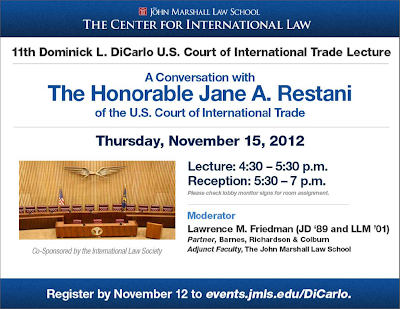
After the very successful DiCarlo Lecture at John Marshall this week, I was talking to colleagues and students about the history of funny tariff classification cases. The topics of G.I. Joe and X-Men came up. This lead to a discussion of my moot court argument over to what species Luke Skywalker and Han Solo belong. The result of that question impacts whether their plastic likenesses are dolls or other toys. Because people may be looking for that, I offer this link to the older post.

CBP's Instructions on Panama TPA

Image
Read them here. That is all.

Law & Order: CBP

Image
It is not often that case at the Court of International Trade takes on the flavor of a courtroom drama. It does happen, such as in the case of international intrigue and an an importation gone wrong . Recently, the Court decided another case that has the possibility of being turned into the most boring legal thriller ever, which is a step up from the usual customs case. By way of background, it is important to know that not everything that transits the United States actually enters the commerce of the nation or is subject to a customs entry. One exception to the normal consumption entry process is the entry for transportation and exportation. See 19 USC § 1553(a).  Under this process, merchandise arrives at a port in the United States and is transported under bond to another port for export. The bonded carrier has certain responsibilities to prove exportation and, if it can't, then it risks being responsible for the duties owed and possible penalties. That was the situation in...

DiCarlo Lecture: Nov. 15, 2012

Image
Register here.

You can Tune A Piano

Image
But tunafish in pouches is hard to classify. In Del Monte Corporation v. United States , the Court of International Trade had to determine the correct classification of tunafish in microwaveable pouches from Thailand. The nub of the problem here is that the tuna was packed with sauces of various descriptions. Specifically, there was tuna with lemon and cracked pepper and lightly seasoned yellowfin tuna. The problem here is that tuna in airtight containers is subject to a 6% or 12.5% rate of duty when not packed in oil (depending on origin, etc.). On the other hand, tuna packed in oil is subject to a 35% rate of duty. For comparison, look at 1604.14.22, 1604.14.30 and 1604.14.10. Thus, the ingredients in the sauce became the key issue. The lemon pepper sauce contained sunflower oil along with water, vinegar, and other materials. The oil made up about 2.48% of the weight of the product. The lighlty seasoned sauce also contained sunflower oil and other materials. In this pouch, th...