Posts

Broker Penalty by Default

I am barely back from a brief vacation. I note that in the ramp up to being a way from the office and while I was gone, the U.S. Court of International Trade did not stop pushing out decisions. So, this is the first in what should be a small group of catching-up posts. Unit ed States v. Alejandro Santos is an action to recover a civil penalty from a licensed customhouse broker. That, in and of itself is relatively unusual. In the ordinary circumstance, the importer bears the brunt of the penalty. If you see a broker penalty case, you can usually assume there is some interesting story in the background. In this case, we don't get much in the way of background because the defendant failed to respond to the complaint. Thus, the only question here is whether the uncontested facts as asserted by the government are sufficient to establish its right to recovery. The bottom line is that the government was able to plead facts sufficient to satisfy the Court that it was entitled to a de...

The Tale of theTempura Tariff

Image
R.T. Foods, Inc. v. United States involves the tariff classification of prepared tempura vegetables. Somehow, I was surprised to find out that this is an imported product, though a mental walk through the frozen food isle reminded me that just about any food product can be bagged, frozen, and shipped. In this case, the specific products were a tempura vegetable medley and tempura vegetable bird's nests. The medley consisted of a mix of sweet potato, carrot, something called "wing bean," green bean (or long bean), and eggplant. The bird's nests were julienned carrots, onion, and kale mixed together. Both products were dipped in tempura batter, frozen, packed and shipped. Before it could get to the classification issue, the Court of International Trade had to deal with a jurisdictional issue. Remember that for the Court to have jurisdiction to hear a classification case, the importer must have filed a protest within 180 days after the date of liquidation and filed a ...

Headline News

Image
Russia and Moldova to get Permanent Normal Trade status. Canadians and Americans indicted for smuggling narwhal tusks. It's the holiday of your choice season. Be on the lookout for counterfeit goods .

A Saucy Decision

Generally, if I fall behind in my effort to report on decisions of the Court of International Trade, it is because I am busy. Such is the case currently. I have been traveling about the country for various events and business meetings. At the present, I am in Detroit having just enjoyed a shwarma dinner and a brief interlude with an elliptical machine. Now, I will take advantage of free WiFi to catch up on a relatively interesting case that I have so far failed to cover. That case is International Custom Products v. United States . If that sounds familiar to you it is because this case has been in the Court of International Trade and the Federal Circuit in one form or another since 2005. The basic underlying issue is whether a prepared food product is classifiable as a dairy product or as a sauce base. This matters a lot because if it is a food product and the entries at issue were made without proper quota, the rate of duty owed increases 2400%. That is the very definition of a cl...

Customs Reauthorization Introduced

For ages, the trade has been expecting a bill to continue funding Customs and Border Protection and to make changes to facilitate legitimate trade. A bill has been introduced by Ways & Means Trade Subcommittee Chair Kevin Brady (R-TX) covering some of that ground. Here is a link to the bill summary . Here is the full text . A few highlights include: Section 102(b) creates the office of Trade Advocate to serve as a liaison between the trade and Customs and Border Protection Field Operations would be transferred to the Office of International Trade under Section 102(d) The creation of an inter-agency Customs Review Board to provide comments on proposed regulatory changes Under Section 203, CBP must provide to Congress a report on its plans for completing the implementation of ACE A prohibition on agencies using ITDS from also using other electronic systems for cargo clearance It appears that cargo data previously only used for cargo safety and security will now be available...

SCOTUS Updates

Yesterday was the Judicial Conference of the U.S. Court of International Trade, which is the biennial meeting of the judges and bar of the Court. There were some very interesting discussions about efforts to harmonize WTO dispute law, Customs seizures, and practice before the Court. Congratulations to the planning committee and the Court of International Trade staff for putting together the program. If you are interested, you can read the papers here . During the conference, it was announced that the Supreme Court had acted on two petitions for review in Customs cases. In the first, the Supreme Court denied certiorari in Hitachi (see here  and here ). As a result, Customs has no obligation to decide a protest before the two-year deadline. This means that if an importer wants to force a decision, it has no choice but to use the accelerated disposition process, which might be better termed "accelerated denial." The Supreme Court also denied certiorari in Alden Leeds (see...

Classification Litigation Can be Complex

Image
Samsung International, Inc. v. U.S . proves that point. If you are interested in Samsung litigation that does not involve Apple, read on. At its base, this is a case about whether plasma televisions and video monitors made in Mexico are entitled to be treated as originating under the North American Free Trade Agreement. If so, they may enter the United States free of duty and merchandise processing fee. The problem for Samsung is that the imported units include an assembly from Korea that consists of a plasma flat panel and various support electronics. Under the relevant NAFTA rules of origin, if that non-originating Korean assembly is classifiable as a "flat panel screen assembly" of 8529.90.53 in the HTSUS, then it fails to satisfy the tariff shift requirement of the NAFTA rule of origin. So, the question is whether two specific configurations of subassemblies are FPSA's. It turns out that is a complicated question because FPSA is not defined in the tariff nor in t...

Is Luke Skywalker Still Human?

Image
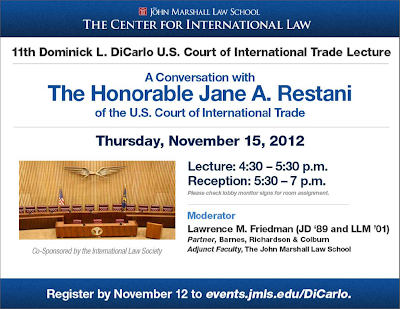
After the very successful DiCarlo Lecture at John Marshall this week, I was talking to colleagues and students about the history of funny tariff classification cases. The topics of G.I. Joe and X-Men came up. This lead to a discussion of my moot court argument over to what species Luke Skywalker and Han Solo belong. The result of that question impacts whether their plastic likenesses are dolls or other toys. Because people may be looking for that, I offer this link to the older post.

CBP's Instructions on Panama TPA

Image
Read them here. That is all.

Law & Order: CBP

Image
It is not often that case at the Court of International Trade takes on the flavor of a courtroom drama. It does happen, such as in the case of international intrigue and an an importation gone wrong . Recently, the Court decided another case that has the possibility of being turned into the most boring legal thriller ever, which is a step up from the usual customs case. By way of background, it is important to know that not everything that transits the United States actually enters the commerce of the nation or is subject to a customs entry. One exception to the normal consumption entry process is the entry for transportation and exportation. See 19 USC § 1553(a).  Under this process, merchandise arrives at a port in the United States and is transported under bond to another port for export. The bonded carrier has certain responsibilities to prove exportation and, if it can't, then it risks being responsible for the duties owed and possible penalties. That was the situation in...

DiCarlo Lecture: Nov. 15, 2012

Image
Register here.

You can Tune A Piano

Image
But tunafish in pouches is hard to classify. In Del Monte Corporation v. United States , the Court of International Trade had to determine the correct classification of tunafish in microwaveable pouches from Thailand. The nub of the problem here is that the tuna was packed with sauces of various descriptions. Specifically, there was tuna with lemon and cracked pepper and lightly seasoned yellowfin tuna. The problem here is that tuna in airtight containers is subject to a 6% or 12.5% rate of duty when not packed in oil (depending on origin, etc.). On the other hand, tuna packed in oil is subject to a 35% rate of duty. For comparison, look at 1604.14.22, 1604.14.30 and 1604.14.10. Thus, the ingredients in the sauce became the key issue. The lemon pepper sauce contained sunflower oil along with water, vinegar, and other materials. The oil made up about 2.48% of the weight of the product. The lighlty seasoned sauce also contained sunflower oil and other materials. In this pouch, th...

Ancient Coins, Modern Courts

Image
Despite what casual readers of this blog might think, customs law is not all about classification, value, and NAFTA. It actually covers a wide range of issues, many of which involve regulations that Customs and Border Protection enforces for other agencies. By way of example, you may already know that I have a strange fascination with the illegal (and reprehensible) trade in endangered species . Another interest of mine is the legal and illegal trade in cultural property . A recent decision of the United States Court of Appeals for the Fourth Circuit discusses the regulation of trade in cultural property with respect to ancient coins. By way of background, the Convention on Cultural Property Implementation Act ("CPIA") permits foreign governments, known as State Parties, to request that the United States prohibit the unauthorized importation of culturally significant items. The intent here is to staunch the traffic in illegally looted artifacts. To...

U.S.-Canada Cargo Security

I was recently in Toronto to speak to the Canadian Transport Lawyers Association about the so-called Beyond the Border Action Plan . One of the initiatives under that project is a pilot at the Prince Rupert port of entry in Canada to harmonize cargo screening. The ultimate goal is to move to an environment in which cargo can be screened once and admitted twice. Here is the text of the U.S. announcement of the pilot: U.S. and Canada Announce New Pilot to Strengthen Cargo Security (Tuesday, October 23, 2012) Washington — The United States and Canada announced the launch of the Prince Rupert Pilot to strengthen cargo security at the Canada-U.S. border as part of the Integrated Cargo Security Strategy in the Beyond the Border Action Plan. The pilot focuses on harmonizing the screening process for maritime cargo between the two countries. “The Prince Rupert pilot implemented under the Integrated Cargo Security Strategy is key to the ongoing efforts to facilitate legitimate trade...

Hey Panama, Happy Halloween

The U.S.-Panama Trade Promotion Agreement comes into effect on October 31, 2012. According to the USTR, 87 percent of exports from the U.S. will become duty-free when the agreement is effective. That includes 56% of U.S. agricultural exports to Panama. To the best of my knowledge, Customs and Border Protection has not yet published a memo on making claims under the UPTPA. I would anticipate the formalities to be similar to other TPA procedures (including these for Peru ). I'll do my best to update this when something is posted.

Pass an FA? Go Directly to ISA.

If you want, that is. Here are the details  courtesy of my law firm. I remain skeptical of ISA benefits for companies that are sufficiently compliant to be in ISA, but that may just be me.

For Wilton, Classification is Not a Piece of Cake

Image
OK, I admit that is a strained pun. This particular Wilton case  apparently has nothing to do with cake decorating paraphernalia. Rather, it has to do with hand operated decorative paper punches. These are items used by people who understand the term "scrapbook" to be a verb. I gather the punches are similar to this item , although Wilton describes it as for making edible shapes for cake decoration and not for the production of scrapbooks and similar crafty pastimes. For a brief time, my mother was a freelance cake decorator. As a result, I ate far too many practice and rejected butter-cream roses in my youth. Thus, this die-punch system seems like cheating to me. The tariff provisions at issue were Heading 8203, which covers, among other things, "perforating punches and similar hand tools" and 8441, which covers "Other machinery for making up paper pulp, paper or paperboard, including cutting machines of all kinds, and parts t...

Update in Active Frontier

As you might gather from the title of this post, there has been more activity in the Active Frontier case. I previously posted about the question of whether the United States had properly pleaded the materiality of an allegedly false statement of origin. After the previous decision, the Court of International Trade gave the United States 30 days in which to amend its complaint to set forth facts showing that it is entitled to relief. In response, the U.S. filed a motion to amend but failed to attach an amended complaint to the motion. Rather, the motion stated that the government would amend the complaint with respect to the element of materiality within three days of the Court granting the order. This implies (at least to me) that the amended complaint was pretty much ready to go. But, without the document to review, the Court found no way to determine whether "justice . . . requires" allowing the amendment. Thus, the Court denied the motion, adding that the amendment s...

Seizures Go to District Courts

Remember how excited I was about CBB Group Inc. v. United States ? That was the case about the exclusion of merchandise from the United States and reminding the world that exclusions, which are not seizures, are protestable events. Denied protests of exclusions end up in the Court of International Trade. In a recent case, PRP Trading Corp. v. United States , the Court revisited this topic, but with an unfortunate twist. The goods involved were aluminum extrusions allegedly from Malaysia. Customs and Border Protection detained that merchandise on the suspicion that it might have a different country of origin. While not discussed in the case, this likely relates to the fact that there is an antidumping duty order on aluminum extrusions from China. Once the importer provided the merchandise to Customs for examination, Customs had 30 days to decide what to do with the merchandise. For two of the entries, the 30 days elapsed without a decision, causing the goods to be legally "deem...

Mozzarella Mafia?

Image
Hat tip to my friend Paul who alerted me to this story . Read the article.  The upshot is that police officers are being charged with smuggling American-origin cheese into Canada for sale to pizzerias. Apparently, American-origin cheese (as opposed to "American cheese") costs roughly a third of the equivalent in Canada. Thus, the officers were making $1 thousand or more per run to the U.S. cheese monger. Mayor McCheese could not be contacted for a statement.